

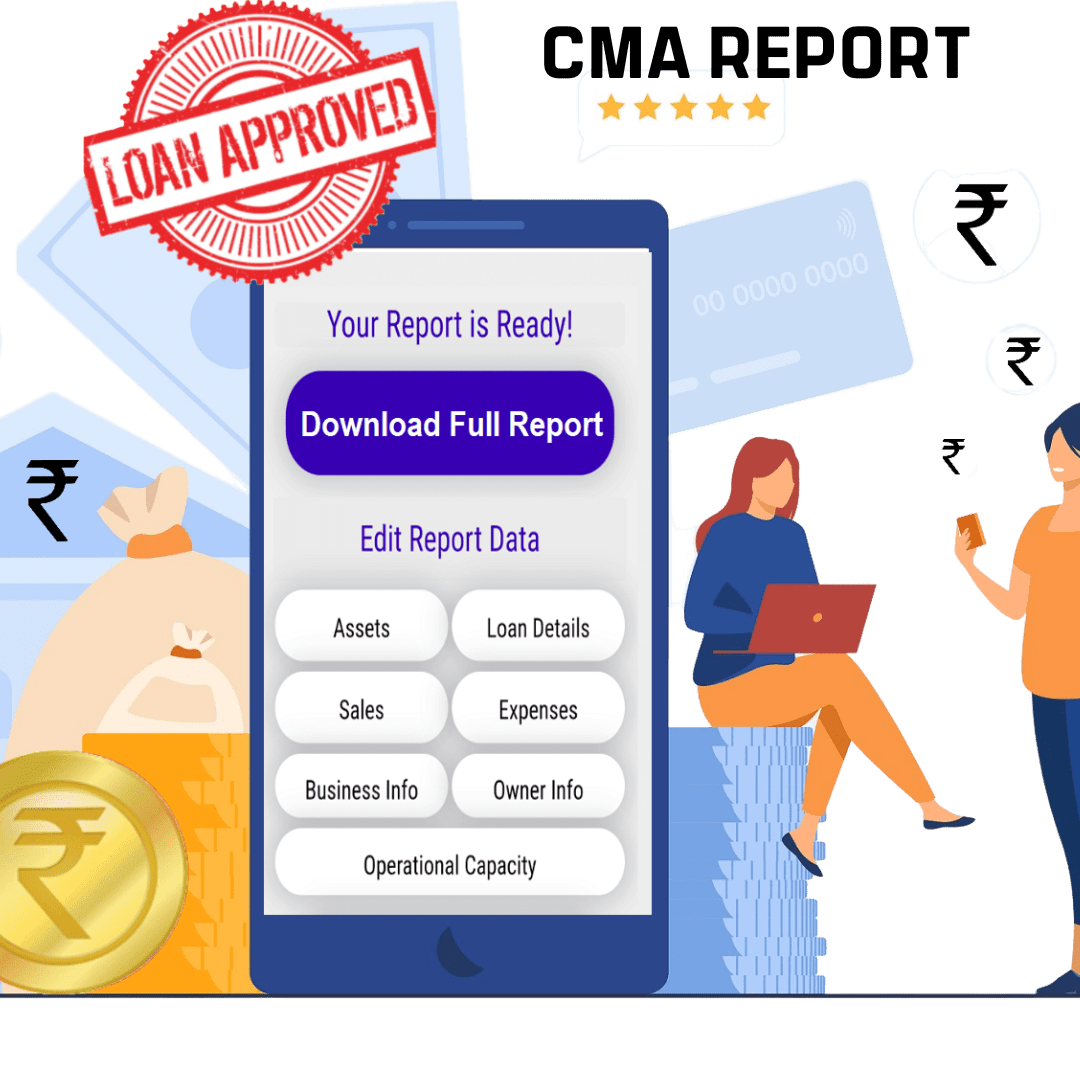
CMA Report

A Credit Monitoring Arrangement (CMA) report
CMA Report is part of the necessary documentation required by businesses that compiles the past performance of the same, as well future projections in a specific format that allows for invested stakeholders to quickly assess the financial health of the undertaking. Most banks require loan applicants to prepare such reports in order to observe whether the capital required could be used for growth and eventual repayment of the same.
Since a well-made CMA Report Preparation could mean the difference between getting a loan and getting rejected, leave us the headache of getting the CMA Report Preparation. Hiring a consultation with us ensures that we can put our effort into compiling the report for you, and you can put your effort into driving up the growth of your business.
In stock
₹19,999 ₹39,999
Credit Monitoring Arrangement (CMA)
The Credit Monitoring Arrangement (CMA) report has been in activity since October 1988. Somewhere in the range of 1965 and 1988, the Credit Authorisation Scheme (CAS) was the vital instrument of credit control. CAS is being utilized by RBI to manage bank credits surpassing the recommended credit restricts straightforwardly.
Under the Credit Authorisation Scheme (CAS), earlier endorsement by the RBI for credit above determined limits was required. These circumstances and the constraints of credit were reconsidered occasionally. At first, the Credit Authorisation Scheme (CAS) was seen as an action to forestall usage of scant credit assets by a few huge borrowers. Afterward, the suggestions by the Chore Committee and Tandon Group were consolidated in the CAS examination of credit recommendations by banks.
For the most part, the RBI authorisation included long deferrals, which was loathed by the banks and their clients. Likewise, their procedure for checking the payment of bank credit was a worry.
CMA report?
CMA report likewise referred to known as Credit Monitoring Arrangement report is the report showing the projected presentation and the previous exhibition of a business in monetary terms. It is incorporated with every one of the expected monetary proportions and measurements to help Financial Analysts and Bankers to learn the monetary soundness of a business.
The majority of the Banking and Financial Institution demand the candidate (Business Loan Applicant) to set up a Credit Monitoring Arrangement report (CMA report) to figure out the stream and utilization of assets in a business. A CMA report which is expertly arranged can upgrade the possibilities getting a bank credit.
Under the Credit Monitoring Arrangement (CMA), banks have been allowed for authorizing credit recommendations (of enormous borrowers) after nitty gritty examination of the past presentation. There is one more prerequisite for the Banks. They need to present the enormous credit proposition to the Reserve Bank of India for post-authorize investigation. These recommendations include working capital restrictions of Rupees 500 lakhs (5 crores) or more or potentially term advance in overabundance of Rupees 200 lakhs (2 crores).
Which are the statements covered in the CMA report?
Particulars of Current & Proposed Limits
The first statement in the Credit Monitoring Arrangement (CMA) report states about the existing fund & non-fund based credit limits, their usage limits and history. In addition to this, the statement also contain the proposed or applied limit of the borrower. This document is a basic document which is to be provided by the borrower to the banker.
Operating Statement
This is the second statement which indicates the borrower’s business plan showing the Current Sales, profit before & after tax, sales projections, direct & indirect expenses, and profit position for 3 to 5 years. These requirements are case to case specific on the basis of the borrowers Working Capital request. This is a scientific analysis of existing & projected profit-generating capacity of the borrower.
Analysis of Balance Sheet
This is the third statement in the CMA data, this statement contains an analysis of the current & projected financial years. It helps in providing a comprehensive analysis of current & non-current assets, current & non-current liabilities and cash & bank position of the borrower. This statement also specifies the net worth position of the borrower for the future projected years. As the name says, it is the analysis of the Balance sheet and gives a complete picture of the financial position of the borrower.
Comparative Statement of Current Asset & Current Liabilities
This is the fourth statement which provides the comparative analysis of the movement of the current assets & liabilities. Basically, this analysis helps to decide the capacity of the borrower to meet the working capital requirements and the actual working capital cycle for the projected period.
Calculation of Maximum permissible Bank Finance (MPBF)
This is the fifth statement and a very important one. This includes a calculation which indicates the Maximum Permissible Bank Finance. It shows the borrower’s capacity to borrow money.
Fund Flow Statement
The next statement is the Fund flow analysis for the current & projected period. In this analysis, it indicates the fund position of the borrower with reference to the projected balance sheets and MPBF (Maximum Permissible Bank Finance) calculations. The main objective of this statement is to capture the movement of the fund for the given period.
Ratio Analysis
This is the last statement in Credit Monitoring Arrangement report (CMA report) which provides key Financial Ratios for the Financial Analysts and Bankers use. The basic key ratios are GP (Gross profit) ratio, Net profit ratio, Current ratio, Quick ratio, Stock turnover ratio, Net worth, the ratio of Net worth to Liabilities, DP limit, MPBF, Asset turnover, Current asset turnover, Working capital turnover, Fixed asset turnover, Debt-Equity ratio etc.
Other documents/Information required to prepare CMA
- Previous 2 years Audited Financials
- Latest Sanction letter (in case of renewal)
- Provisional Financial for the current year
- Term Loan Repayment Schedule,( if any)
- Details of proposed enhancement (if any) along with the terms and conditions
Related products
-
Bharat Inc., LOANS, LOANS & FINANCE
Gold Loan
Gold Loan
Gold loan or loan against gold is a secured loan in which a customer pledges his/her gold ornaments as collateral. The company, in turn, gives a loan amount as per the market value of gold to the customer. It is a very quick and easy way of fulfilling one’s financial needs as compared to the other loans.
SKU: EBR9V5QO -
Bharat Inc., LOANS, LOANS & FINANCE
Collateral Free Loans
COLLATERAL FREE LOANS
Collateral Free Loan of Upto Rs. 1 Cr Can be Obtained by New Entrepreneurs and existing small businesses in India.
The loan provides by the bank without supporting any security is known as security free. A special type of collateral free loan scheme is available in India under the Credit Guarantee Fund Trust Scheme for Micro & Small Enterprises (CGTMSE). Under this scheme, the micro and small enterprises (MSEs) are eligible for collateral-free loans up to Rs.1. crore in values.
SKU: EBSPTC8G -
Bharat Inc., LOANS, LOANS & FINANCE
Vehicle Loan
Vehicle Loans:
A short-term loan in which the borrower’s vehicle title is used as collateral. The borrower must be the lien holder. If the loan is not repaid, the lender can take ownership of the car and sell it to recoup the loan amount.
SKU: EBO9EU7S