


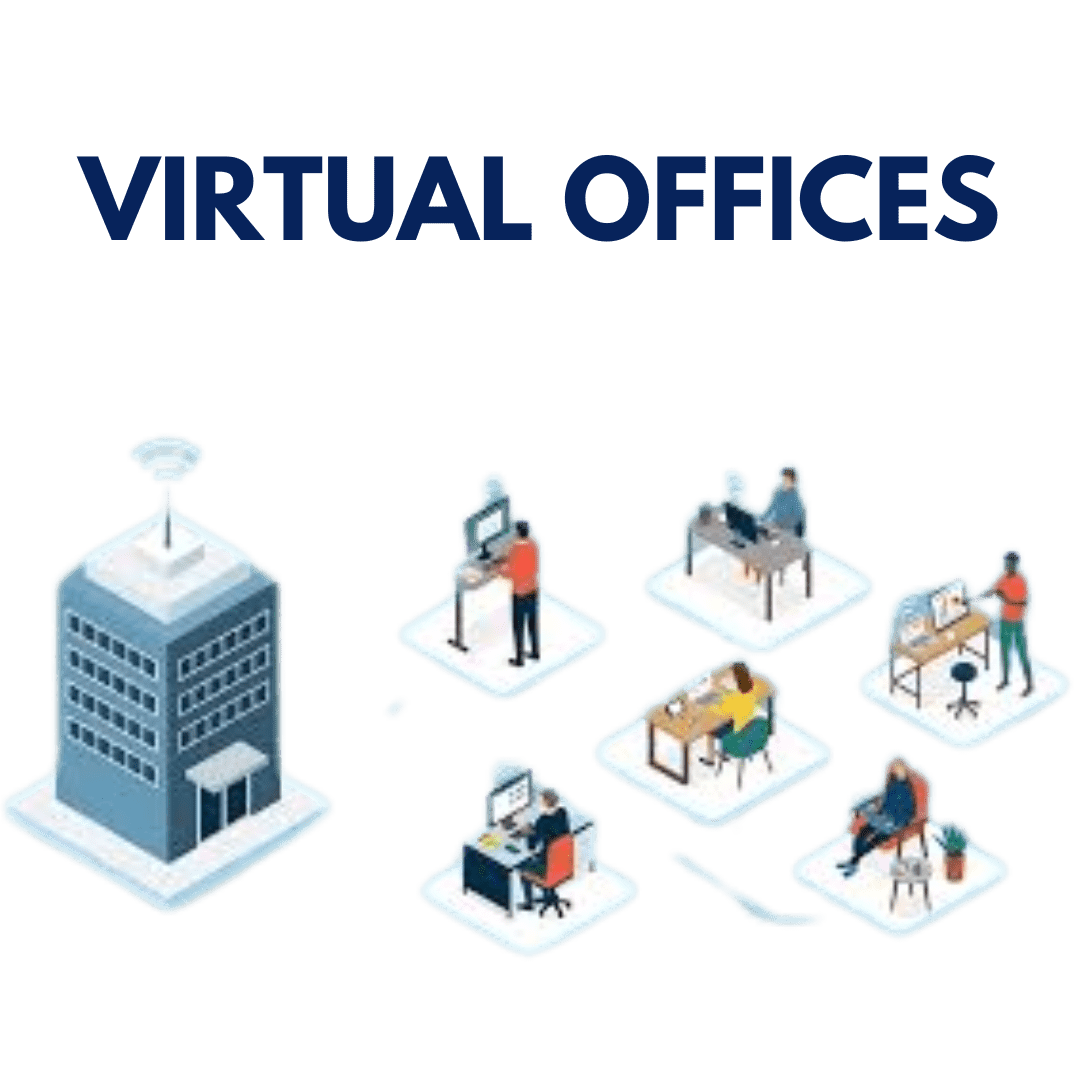
Virtual Offices

The creation of web-based office productivity software and services, such as videoconferencing, has helped drive the growth in virtual offices.
₹9,999
VIRTUAL OFFICES
Description: Virtual offices operate as one unit to serve customers but do not exist in a fixed location. This type of setup is especially popular with start-ups and small businesses that want to minimize overhead. The creation of web-based office productivity software and services, such as videoconferencing, has helped drive the growth in virtual offices.
Key Takeaways:
- A virtual office is a company that operates as one unit and has a physical mailing address, but does not exist in one specific location.
- The development of tools such as videoconferencing and messaging services has led to the increased usage of the virtual office.
- The costs of operating a virtual office are much less than a traditional office, and that’s why this type of setup is popular among small businesses and start-ups.
- A virtual office arrangement expands job options for employees and hiring options for businesses.
- While the virtual office is typically a less expensive option for business, some services, like phone answering and videoconferencing, might have limited accessibility.
Benefits for Virtual Office:
- Virtual Office Reduced Facility Cost: Virtual office enables an organization to reduce its cost that is required in setting up a physical office. Instead of having a large physical office, the organization can reduce its size considerably as many employees work for office without attending it physically. This helps in reducing real estate cost, maintenance cost, and cost of physical commuting of employees.
- Virtual Office Reduced Equipment Cost: A physical office requires equipment to be used by employees while working in the office. In a virtual office, no such equipment is required. What is required is the development of local area network through which employees are connected. This arrangement is more relevant for information workers. For other categories of employees, other electronic communication tools are required.
- Virtual Office Emphasis on Formal Communication: A virtual office places emphasis on formal network of communication which ensures the orderly flow of communication throughout the organization. This further ensures that only officially-relevant communication passes through the network unlike the physical offices in which much time is wasted in informal communication without much meaningful exchange of ideas and thoughts.
- Virtual Office Reduces Work Stoppages: A virtual office can work even during some tolerable events which may hamper the work of physical offices such as storms, hurricanes, floods, etc. Since the employees are not required to attend the office physically, they can continue to work during such events.
- Social Interaction and Social Contribution: A virtual office enables employees to engage in social interaction as they can save time because of absence of physical commuting which otherwise consumes lot of employees’ time. Similarly, a virtual office enables those persons to work who might not be in a position to attend office physically such as handicapped people, elderly people, parents with young children, and so on.
Who Needs A Virtual Office: With new business models rapidly replacing traditional models, the business needs are also changing. Today, businesses work remotely with global teams.
- Geographically scattered teams: Teams that are not confined to a geographical location often use virtual addresses to register their business and get official work done.
- Virtual entrepreneurs: This concept suits best to freelancers, business consultants, bloggers, digital marketers, and digital nomads who work from anywhere but need an address for official and mailing purpose.
- Start-ups and garage businesses: Often, start-ups and small businesses start their operations from home. But having a home address on Google search or website isn’t professional. Hence they go for virtual office addresses.
- Registered businesses with remote teams: Registered businesses with remote teams often use virtual office services to avail the benefits of virtual addresses and add-on services.
Documents required for Virtual Offices:
- Aadhar Card of the signatory
- Business Registration certificate
- incorporation certificate provided by the Ministry of Corporate Affairs
- Identity proof of the prime authorized signatory.
- Address proof of the prime authorized signatory.
- PAN card of the Applicant/Business.
- Digital Signature Certificate of the authorized person.
- Indian Bank Account Number.
Different types of Virtual Office Services in India:
- Access to copier or fax or scanner
- Mail handling
- Locker services
- Courier services
- Fixed monthly access to meeting rooms
- Telephone answering
Measures for Making Virtual Office Effective:
- Providing Computer Resources: A large part of a virtual office is technology. Therefore, companies need to invest in computer resources and other such technological equipment that will facilitate the workspace to function efficiently.
- Providing Access to Information: Making the right information available to the right person is extremely necessary. Easy access to information is a prerequisite of any virtual office. Employees in these kinds of workplaces function best with an information-oriented approach to things and it helps any operation become successful.
- Arrangement for Forwarding Phone Calls: Every virtual office requires some sort of help from a physical office. Making arrangement for forwarding phone calls to concerned employees is one of these helps. Therefore, there should be someone at the fixed office with the responsibility for forwarding phone calls to telecommuters. Organization can also make use of a voice messaging system that enables the telecommuters to access it from their own workplaces.
- Arranging Conference Calls: A conference call enables more than two persons to participate in a telephonic conversation at the same time. This helps the telecommuters to exchange their views and ideas among themselves without meeting physically. Such views and ideas are quite helpful in solving those problems that cannot be solved individually. In order to take the advantage of this phenomenon, the organization should arrange conference calls at regular intervals.
- Arranging Regular Meetings: Though in virtual office systems, face-to-face meeting among employees may not be required to do their work technically, it is better that they meet their fellow workers on certain pre-determined time at regular intervals. Such meetings help them in understanding each other in a much better way and develop belongingness and community feeling. Therefore, the organization should make arrangement for such meetings and informing all the concerned telecommuters.
- Follow-up of Work Routine: Telecommuters should be encouraged to develop and follow their own work routine so that their attention is not distracted during their working hours. If the telecommuters develop and follow such a work routine, perhaps their family members, friends, and others may hesitate in disturbing them during their working hours even at home or any other place.
Related products
-
-
Bharat Inc., IPR & QUALITY, TAX FILINGS & COMPLIANCE
TAN Registration
TAN Registration
Tax Deduction Account Number or Tax Collection Account Number is a 10-digit alphanumeric number issued by the Income-tax Department (we will refer to it as TAN). TAN
is to be obtained by all persons who are responsible for deducting tax at source (TDS) or
who are required to collect tax at source (TCS).SKU: EBIKRWJC -
Bharat Inc., IPR & QUALITY, Start Up Registration
StartUp India Registration
Startup India Registration
Startup India is a flagship initiative of the Government of India, intended to build a strong ecosystem that is conducive for the growth of startup businesses, to drive sustainable economic growth and generate large scale employment opportunities. The Government through this initiative aims to empower startups to grow through innovation and design.
Several programs have been undertaken since the launch of the initiative on 16th of January, 2016 by Hon’ble Prime Minister, to contribute to his vision of transforming India into a country of job creators instead of job seekers. These programs have catalyzed the startup culture, with startups getting recognized through the Startup India initiative and many entrepreneurs availing the benefits of starting their own business in India.
SKU: EBET8G5S -
Bharat Inc., IPR & QUALITY, TAX FILINGS & COMPLIANCE
MPEDA Registration
MPEDA REGISTRATION
MPEDA registration is mandatory for exports of Fish and Fishery products from India. With the online registration system, any prospective exporter can apply online for getting MPEDA Registration. The documents are submitted by uploading scanned copies in pdf format and the payment is accepted through a payment gateway. The existing exporters can apply online for renewals, endorsements or cancellations. The applicant can see the status of his application through his login credentials
SKU: EB5UTZ1J